
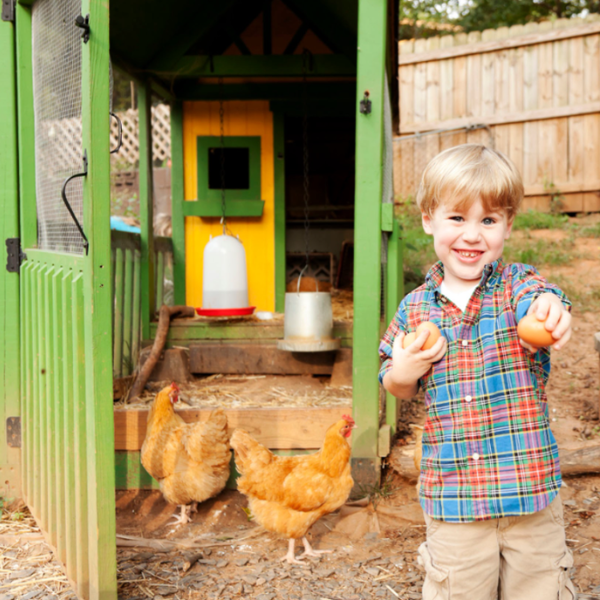
Keeping a small flock in your garden yields far more than a reliable supply of fresh eggs for your morning breakfast. A well-managed chicken coop can transform a standard residential property into a dynamic, living laboratory. For parents of young children aged 3 to 6, this offers an unparalleled opportunity for tactile, screen-free education that grounds them in the natural world.
Many children growing up in modern urban environments lack a direct connection to the provenance of their food. Food is often seen as something that simply appears on a supermarket shelf. We believe that closing this gap at an early age builds empathetic, capable, and grounded young people.
This guide serves as a practical roadmap for parents. Below, we explore exactly how a backyard flock can become a foundational teaching tool. We will cover methods for teaching basic numeracy, enhancing sensory development, and instilling a strong sense of responsibility through daily chores. Over the coming weeks, we will expand this series to cover older age groups, providing you with a complete curriculum for your backyard.
The Modern Urban Disconnect
We live in an era where digital screens command much of a child’s attention. While technology has its place, early childhood development relies heavily on the physical world. Children at this stage need to touch, hear, smell, and observe tangible consequences.
A garden environment offers a reprieve from digital overload, but adding livestock elevates the space completely. Chickens bring movement, sound, and a routine that demands attention. They require care regardless of the weather or the day of the week. By bringing a flock into your space, you instantly create a focal point for daily outdoor activity that engages all the senses.
Sensory Development and Tactile Learning
For children aged 3 to 6, learning is primarily a sensory experience. They learn by interacting physically with their environment. A backyard flock provides a safe, structured way to explore these senses.
-
Handling Fragile Items: One of the most valuable lessons a child can learn is physical mindfulness. Tasking a young child with carrying a freshly laid egg from the nest box to the kitchen bench helps develop fine motor control. They must learn to balance their grip, ensuring they hold the egg securely without applying too much pressure. When an egg inevitably breaks, it provides a gentle lesson in cause and effect.
-
Understanding Textures: A chicken coop is full of contrasting textures. Children can feel the difference between the smooth shell of an egg, the soft downy feathers of a hen, the rough bark of the timber coop, and the dry crunch of the wood shavings used for bedding.
-
Auditory Recognition: Flocks have a complex language. Children quickly learn to distinguish between the quiet clucking of a content hen foraging in the soil and the louder, urgent calls that signal alarm or the arrival of an egg. This encourages active listening and environmental awareness.
The Foundation of Numeracy and Basic Maths
Before children sit at a desk to learn arithmetic, they need concrete examples of numbers in the real world. Egg collection is an exceptionally practical way to introduce foundational maths.
-
Practical Counting: Make the daily egg collection a shared chore. Have your child count each egg out loud as they place it into the basket. The physical act of moving the object while speaking the number reinforces the concept of quantity.
-
Basic Addition: You can turn the nesting box into a simple puzzle. Ask questions like, “We found two eggs in the wooden box and one egg in the corner. How many do we have altogether?”
-
Pattern Recognition: Eggs are rarely uniform. Encourage your child to sort the day’s yield by size or slight colour variations. This introduces them to categorisation, a core mathematical skill.
Building Empathy and the Duty of Care
Perhaps the most significant benefit of raising a flock with young children is the development of responsibility. A living creature relies entirely on its keepers for survival.
-
The Weight of Routine: Assign your child a specific, age-appropriate task. Checking the water level in the drinker is a perfect starting point. Explain to them that chickens need clean water every single day. If the task is neglected, the animals will go thirsty. This establishes a duty of care that cannot be replicated by household chores like tidying toys.
-
Respecting Boundaries: Children must learn that animals have boundaries. A flock teaches them to move calmly and quietly, as sudden movements or loud noises cause distress. This translates into deeper empathy for other living creatures and people.
-
Daily Security: Every evening, the flock must be locked securely inside their coop. Having your child participate in this routine teaches them the importance of safety and protection.
The Infrastructure of Learning
To facilitate this education, you need the right setup. The structures in your garden must be durable, safe, and practical.
At GardenStuff, our chicken coops are built specifically for the South African climate. We construct our coops using marine-grade sealers and CCA-treated pine for all ground contact points to prevent rot and ensure longevity. It is important to note that while our designs are robust and secure, no outdoor structure is completely proof against local wildlife. The daily routine of locking the coop at dusk is an essential part of the educational process, teaching children that responsible management is what truly keeps their animals safe.
If you are expanding your garden ecosystem to include vegetables, remember that the nutrient-dense waste from your flock makes an excellent fertiliser. For growing food, we manufacture planter boxes using 100% organic, natural, untreated timber. If you opt for our bottomless raised beds, ensure they are placed directly on natural soil, never on hard surfaces like patios or paving, so the natural soil biology can thrive.
How to Implement This Tomorrow
You do not need to overhaul your entire life to start this process. Begin with small, structured interactions.
-
Establish the Routine: Pick one specific time of day for flock chores and stick to it. Consistency is key for young minds.
-
Narrate the Process: Talk through everything you are doing. “I am checking the lock on the wooden door to make sure it is secure,” or “I am topping up the feed so they have enough energy.”
-
Use Our Resources: We are developing downloadable tracking sheets and observational drawings to help you structure these lessons. These will be available directly on our website soon.
We want to hear how you are implementing these ideas in your own backyard. Feel free to contact us on WhatsApp or by Email with your feedback, suggestions for new lesson modules, or questions about integrating our timber products into your educational space. Nationwide courier delivery is available for our coops, meaning you can establish your backyard classroom anywhere in the country.
Pro Tip: For South African parents starting a flock, always ensure the coop is placed in a spot that receives morning sun but is shaded during the intense afternoon heat, especially during January and February. A cool flock is a healthy, productive flock, and it keeps the daily chores comfortable for your little ones.
